Image courtesy of Sunshine Denney.
Aurora Hons
Staff Writer
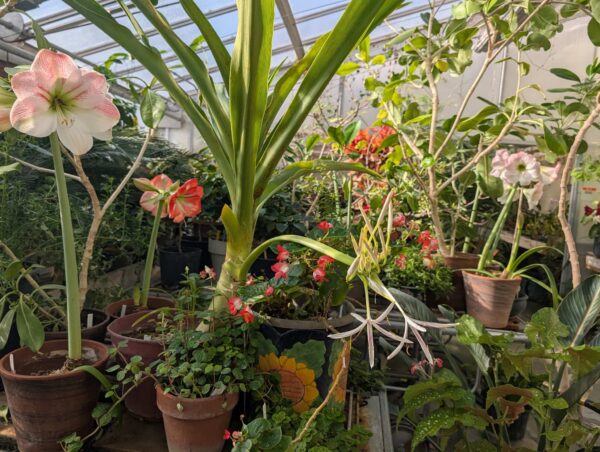
Winter may freeze the campus landscape, but inside the campus greenhouse and gardens, plants thrive year-round, offering students a warm, green refuge that supports learning, relaxation and connection during the coldest months.
For Greenhouse Manager Sunshine Denney, that atmosphere is intentional. “Really the whole point is to create wonder, and give people a biophilic experience even when it’s frozen outside,” Denney said.
ISU operates two greenhouse facilities which faculty can use to support hands-on instruction. “The greenhouse mainly services the biology department. It’s two facilities, the Plant Sciences Building, and then the Gale Life Sciences Building,” Denney said. “Any of the faculty are welcome to use it in aid for teaching their courses.”
Biology and plant science classes rely on the space for labs and research, but the doors are also open for students looking for a quiet place to study or unwind between classes. “Since we’re here every single day I try to just leave the doors open so the students can utilize it as a passive space,” Denney added. The space not only supports academic learning but also offers students a chance to engage with nature, which can benefit their well-being.
Rick Pongratz, Director of the Counseling and Mental Health Center, says there is an incredible amount of scientific research supporting a nature-mental health connection. “As a psychologist I have done research on the link between connection with nature and mental health. I have advocated for more natural green spaces on campus to promote connection with nature,” Pongratz says.
One 2018 study done by Harvard Medical School found that over 20 percent of students reported having six or more stressful life events in the last year. “I hope more students will visit the greenhouse with a mindset of curiosity. It is an important and healing way that we can take a break from screens and the disturbing news we hear so often from all around the world,” Pongratz added. Finding ways to reduce stress and promote well-being has become increasingly important, especially as students face pressures both inside and outside the classroom.
College students are no strangers to stress. But beyond academic pressure and mental fatigue, a growing number are also confronting food insecurity, adding another layer of strain to campus life. “I’m really passionate about native plants, and also food, and the fact that many of our students are experiencing food insecurity, especially our athletes,” Denney said. “So for the last few years outside we’ve also tried to add edible components to our gardens so we can share food.”
A National Postsecondary Student Aid Study found that 23 percent of undergraduates experienced food insecurity. As the greenhouse works to ease this struggle for ISU students, it also cultivates something less measurable– awareness.
Beyond addressing immediate needs like food, the greenhouse offers students a chance to reflect and grow in ways that aren’t always easy to measure. According to Pongratz, time spent among plants can shift how students see themselves and their impact on the world.
“When we slow down and pay attention to plants and how they exist in relationship with soils, insects, and other plants/animals, we start to see metaphors for our own lives,” Pongratz said. “Acknowledging our role in our ecosystem can help us understand our power to help or hurt the world around us.”
As winter continues to cover campus in gray, the greenhouse remains a place where something is always growing. Whether students come for research, reflection or a fresh tomato, the space offers a reminder that even in the coldest seasons, growth is still possible.