Austen Hunzeker
News Editor
No roads, no crowds, no cellphones. Just the sound of a boat’s contact with the water, the current carving the earth, and wildlife noises creating Idaho’s nature scene.
Willis McAleese’s dream was river guiding, and he was living it. But it was 2007, and 10 years of guiding were wearing on him. He would always choose the river over college, but second thoughts were creeping in.
McAleese’s father, also Willis McAleese, a health professor at Idaho State University, swayed him otherwise.
“Why the heck would ya wanna do that?” his dad said.
McAleese knew his dad was right: Life was too short to work hard at uninspiring things, but what inspired Willis other than river guiding?
Woodworking did — specifically, wooden boats.
His dad began the hunt to help McAleese pursue his woodworking aspirations. The Northwest School of Wooden Boatbuilding in Port Hadlock, Washington, seemed promising.
“To me, the magic was in the fact that we could build something like a boat, and then take it out to experience magical days on the river,” McAleese said. “I decided a long time ago that far more important than making lots of money was just being stoked every day.”
McAleese graduated from boat school in 2009. There, he sat through two-hour lectures five days a week and learned to construct small sailboats and tenders.
“This is where my woodworking — and real love for beautiful woods and the different ways they each respond to tools — really started to blossom and solidify,” McAleese said.
As a guide, finding work in the winter was essential, and for McAleese, that looked like construction or cabinet building.
“I started to pick up finer skills in woodworking,” McAleese said. “For most of my stuff, I’m using mountain mahogany. It’s very difficult to work with, and it’s very hard to find big pieces.”
McAleese typically finds the best wood floating on his drift boat in water canyons with his chainsaw. Cutting boards, tables, and what McAleese calls “connection amulets” — necklaces worn as reminders to connect with nature — are just a few items he builds other than boats.
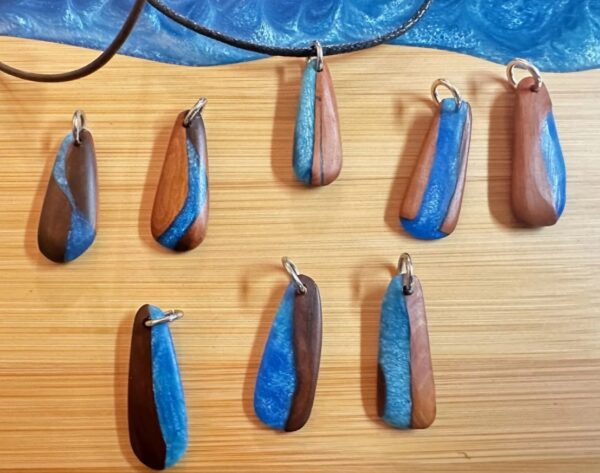
McAleese displays his amulets, coasters, and cutting boards at 5th Street Bagelry in Pocatello and other local coffee shops and bakeries because they “complement the energy that handmade wood products have.”
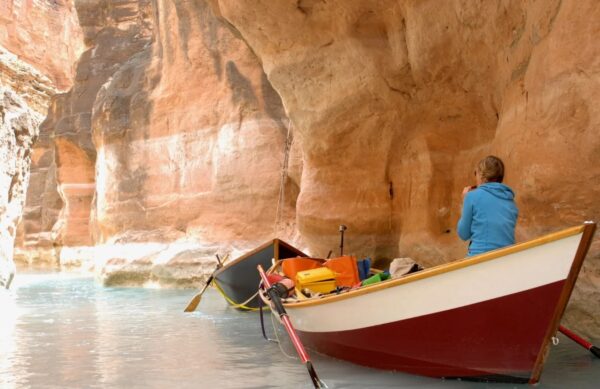
One of his favorite builds is the first boat he crafted as a boat school grad, a Grand Canyon river dory, a drift boat used for river and whitewater trips.
“I built it in minimal shop space and with a much smaller tool library than I have now,” McAleese said. “Lessons were learned.”
The river dory is called the “Sparrow,” and McAleese was able to take her on a 23-day trip down the Colorado River in the Grand Canyon. Today, he has his woodworking business, Lost River Dry Goods, based in Pocatello.
Dan Hobbs, a friend of McAleese, is originally from the suburbs of Massachusetts and exclusively uses northern white ash wood for its straight grain and shock resistance. It is the same material used to make baseball bats.
“Once I came out [to Salmon] and started getting on the river … making a living boating, I was like, well, if I can make a living boating, I can probably make a living woodworking,” Hobbs said.
He, too, was trying to make a living during the winter and started a small business making wooden oars to support himself. He goes to Helena Hardwoods in Montana, as they let him “touch every single piece of wood that [he] needs to get the best ones.”
“I look down the edge to see if the grain is straight,” Hobbs said regarding his process. “Wood’s a natural material. As you cut through it, you are releasing all of these tensions, and a straight board could become a crooked board pretty quickly.”
When wood is acquired, Hobbs returns home to shape the handle, shaft, and blade of the oar, creating a durable and eye-catching final product.
“It’s something that I could be doing when I’m 80,” Hobbs said. “With any craft, the longer you do it, the better you get at it. I intend to continue to do this. … Whether I’m doing it for money or not is the big question.”
Mike Oldham, a friend of both McAleese and Hobbs through river guiding excursions, says he’s seen the power behind handmade, wooden products firsthand.
“When you work with wood and you think about the lifespan of a tree, or whatever the material is, you start thinking about what it’s been through,” Oldham said. “It’s weathered all sorts of crazy droughts and extreme cold, … and it’s kind of like life … It has all these layers to it.”
When asked if he’d ever abandon woodworking, McAleese said, “Nah.”
“I see the future just full of new ideas and new projects to create,” McAleese said. “I hope to show others the power of connection to nature. I would like to show how handmade wooden products, made with love and intention, hold a certain energy that just brings a little bit more joy to this world.”
Lost River Dry Goods is how he aims to accomplish just that.