Austen Hunzeker
News Editor
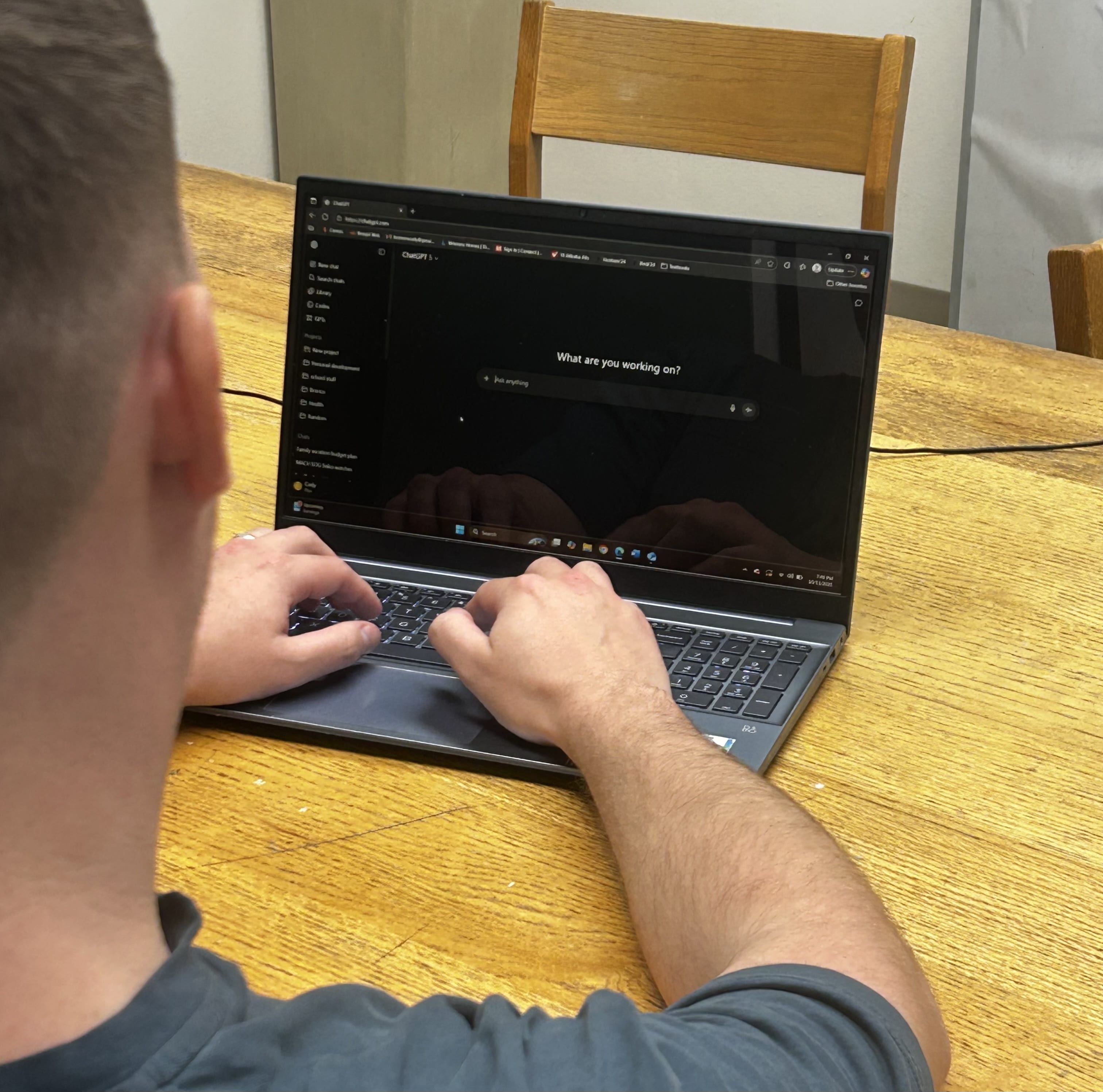
The rise of Artificial Intelligence (AI) has infiltrated the day-to-day happenings at Idaho State University, some applauding its vast capabilities — and others believing it could be the end of human originality.
ISU students and staff participated in anonymous surveys created by The Bengal Newspaper and offered their thoughts surrounding the use of AI in and outside of the classroom. Responses varied: one student called AI “anti-academic” and “anti-art/artists,” while another described it as “a tool” that’s not going away. Questions over AI’s ethical applications are recurring, from data-privacy concerns to academic and creative integrity.
Out of the students and staff who completed the surveys by Oct. 20, 6% of students said they’ve never used AI, while nearly 60% said they use some AI platforms at least once a week, and 15% said they use them multiple times a day. The top three student uses for AI were concluded as using AI for personal questions, help with homework, and work or school-related research.
The staff survey recorded 9.6% saying they’ve never used AI, 66.2% saying they use AI at least once a week with 19.3% using it multiple times a day. The top three staff uses were concluded as using AI for personal questions, to see which percentage of their students’ work is AI-generated, and using AI for research. Staff survey results also concluded that 54.4% allow AI use in the classroom.
Sofia Peach, a senior undergraduate student majoring in economics and Director of Academic Affairs for ASISU, says she uses ChatGPT for job interview prep and making study guides. In one of her courses this semester, a professor expressed concerns over relying too much on AI.
“The professor has been teaching this class for years, and the class average for the first exam was lower than average than previous years,” Peach said. “Homework grades are probably really high, but I bet you the exam grades [are] not as high, just because people might be using AI for homework.”
Peach works at the ISU Writing Center and says the rule of thumb for addressing potential AI-generated papers is to not say anything at all. She can kindly nudge students to cite more sources or write less generally, hoping they will reduce their reliance on AI for their assignments, but that’s it.
“I feel like students can completely cheat their way through a lot of classes at ISU,” Peach said. “I feel like a lot of academic dishonesty is pretty rampant…There’s not much you could do except force everyone to do everything in person, which I don’t know if that’s necessarily practical.”
Additionally, Peach commented on how AI will likely impact the job market in the coming years.
“That’s where businesses want to move. They want to automate things. They want to save money, because labor costs a lot of money,” Peach said. “So if they can automate certain jobs, they will. I mean, it is something I’m thinking about, and I definitely do think it’s possible, especially in the next five years.”
Dr. Michael Thomas, Professor of Biology at ISU, says that since moving coursework to an online format in 2020 due to COVID-19, he too noticed a sudden difference in scores. Going into this year, he’s done a lot of reading, listening to podcasts, and more to prepare his classes to co-exist with AI.
“I started putting my questions for both the exam and homework into ChatGPT a year ago, and it was okay at answering them, but it was getting better and better and better, and by last spring, I had to rewrite everything so that the questions were things that humans could answer but that ChatGPT could not answer,” Thomas said. “Now I’ve totally given up and moved everything back into the classroom.”
Thomas says he misses having more time in class to do “cool stuff,” especially since his focus on teaching is genetics. However, having exams and coursework done in class again seems like the logical solution. He still allows homework to be done outside of the classroom, but does not allow laptops or other electronic devices in class.
Dr. Liza Long, the Idaho State Board of Education’s Academic Technology Program Manager, former AI Fellow, and a current English PhD student at ISU, has come to know the realm of AI well. In studying how AI has impacted first-year college writing instruction, and being a former English Professor herself, Long has been cited by the Modern Language Association and the United Nations Educational, Scientific, and Cultural Organization (UNESCO), as well as nominated for an Open Education Global Award for her work on AI literacy.
As an AI Fellow for the Idaho State Board of Education, she helped establish Idaho universities with AI Catalysts, ISU’s being Professor of English Abraham Romney, whom she meets with every week as the state’s Academic Technology Program Manager to discuss AI at ISU. For her, AI has kept her curious, as she even had ChatGPT generate her Halloween costume as an “AI Queen.”
“What we’re trying to do is make sure that we’re capturing best practices from all the institutions,” Long said about Idaho’s approach to AI. “We’re not taking a prescriptive approach. We’re taking more of a ‘how can we capture the good things all of you are doing,’ and then bringing those in to share more widely. And we’re seeing a lot of interesting things around the state.”
For example, Boise State University is currently testing its own in-house AI system called Boise State AI. With Dr. Jason Blomquist, a Nursing Professor at BSU, Long also recently published results for a statewide faculty survey on AI, which can be viewed at idaho.pressbooks.pub.
“There are some huge red flags, like around student privacy,” Long said. “One thing that has made me angry is when professors will put their students’ work into something like ChatGPT Zero Plagiarism Checker, because I see that as a violation of student privacy and intellectual property rights.”
Long doesn’t see AI taking over the job market, but she does believe it’s already changed people’s jobs.
“I’ve seen jobs go away, new jobs get created, right?” Long said. “I continue to see these tools as being most useful for experts…So what really, really concerns me is how do we train the next generation of experts?”
Long will be presenting on AI at ISU on Nov. 7 as part of the College of Education’s Great Ideas in Teaching conference.
“I personally expect that for these tools to be useful, what we’re going to see is kind of a sea change,” Long said. “I think this is at the college level, toward smaller, less environmentally concerning models that run more locally and are trained for specific tasks. I personally think, and have thought for about a year now, that that’s the most useful application [of AI] in higher education.”