
Jacki Donovan/Life Editor
Jacki Donovan
Life Editor
On Sept. 16, public figures statewide gathered with university leadership to reveal the site for the proposed Nuclear Reactor Innovation Center, where construction of a new Advanced Research and Test Reactor is planned.
Per an ISU press release, “the project will serve as a hub for student learning, applied research, and reactor operations.” Construction is slated to take place at the university’s Business and Research Park on Alvin Ricken Drive.
The university reports the project as part of ISU president Robert Wagner’s overarching administrative “Contract for Idaho,” which aims “to power Idaho’s energy future, train Idaho’s workforce, leverage partnerships and strengthen Idaho’s economy.”
The proposal bears a further resemblance to other recent development efforts on campus by way of its public-private funding model. This time, Idaho Falls nuclear technology company NuCube comprises the other, private half of the partnership behind this proposal.
Per ISU, NuCube “develops factory-built microreactors that provide carbon-free electricity and high-temperature industrial heat.”
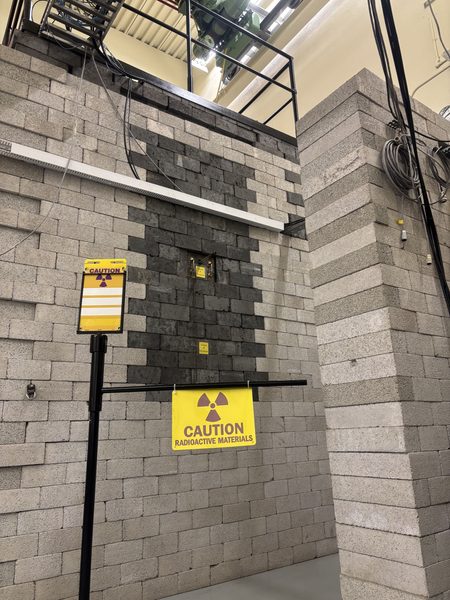
From inside the nuclear engineering program, this proposal has been offered in the context of a legacy of research and operation dating back over fifty years.
“ISU first acquired [its existing training/research reactor] in 1967, and it will continue to run for the foreseeable future,” says reactor operator Theodore Pollock. “It’s not like the proposed reactor is replacing this one.”
Pollock clarifies that ISU is “not unique” in operating decades-old equipment. In fact, ISU’s existing reactor remains the subject of major research.
“Recently, our team completed a full disassembly and reassembly of [ISU’s current reactor],” says Pollock, “and that’s going to be a big paper coming up.”
Although ISU is far from the only university getting research results from Cold War-era hardware, Pollock does not discount the proposal’s potential to improve and expand his program.
“It’s a step in the right direction,” says Pollock. “New equipment for the program is potentially very exciting and overdue.”
At time of publication, we are without a doubt in the early stages of the proposal– insofar as it is difficult to gauge the student outlook on it.
“Honestly, I didn’t know much about [the proposal],” says nuclear engineering freshman Ronan Sheetz.
The prospect of expanding the nuclear engineering program’s research and job training capacity, though, is an appealing one for faculty and students alike.
“Judging by some of my friends that are interning in the industry right now,” says Sheetz, “I feel very confident in [the nuclear engineering] program’s ability to prepare you for the field.”
Pollock shares this sentiment, albeit cautiously.
“When you’re looking at these kinds of multi-year developments, they can prove to be more complex than some other university projects,” Pollock says. “It will be a challenging and rewarding project.”
As it stands, it is business as usual for ISU’s nuclear engineering students – new facilities or not. Sheetz expressed concern for the lack of public knowledge of nuclear power.
“It makes me sad that nuclear incidents have been so sensationalized since Chernobyl,” says Sheetz, “because nuclear energy is going to be the way we power the future.”