Madison Long
Life Editor
Her bubblegum-pink dress shines even before she walks under the stage lights, although now her glittered accents — silver three-inch heels and a bedazzled Apple Watch — sparkle, too.
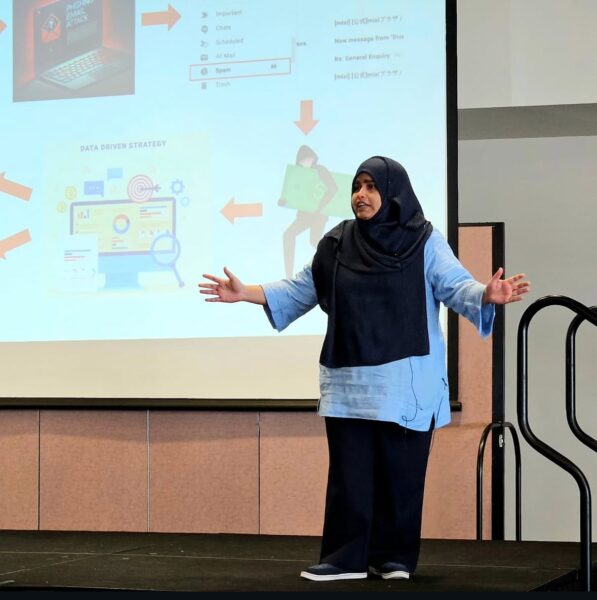
Stephanie Christensen is pursuing a doctorate in Idaho State University’s Nursing Practice program with plans to become a nurse practitioner. But now, she’s role-playing 52-year-old Rachel, a woman experiencing all the Class A symptoms of menopause, in front of three judges and her professors. She only has three minutes to talk.
Her research, which started as a social media survey on women’s attitudes about menopause, turned into an educational video on hormone replacement therapy. She explains that in a post-survey of 50 women, 90% were willing to try HRT, when previously only 50% considered the option.
“This proves that education can turn fear into confidence and uncertainty into empowerment,” Christensen says in her thesis, “Optimizing Hormone-Replacement Therapy in Menopausal Patient Care.” “Menopause isn’t the end of you, it’s the beginning of a beautiful new chapter. And women deserve to enter that, bold, brave and brilliant.”
Christensen is only one of 28 nervous speakers at ISU Graduate School’s ninth annual Three-Minute Thesis Competition, held Nov. 13. According to Interim Dean Tracy Collum, ISU’s graduate program started with only 57 grad students nearly 71 years ago. Now, about 2,100 students are enrolled in 2025.
The research communication competition was originally developed by the University of Queensland in 2008, where participants consolidate their ideas and research discoveries into a three-minute presentation for a non-specialist crowd. Competitors create a single PowerPoint slide and capture the audience’s attention, all while a large clock ticks down the seconds overhead.
“This is a wonderful opportunity to glimpse the breadth and impact of research happening here at Idaho State University, something we’re very proud of,” ISU President Robert Wagner said during the event’s welcome speech. “You’ll hear about questions that push boundaries, projects that tackle real-world problems and ideas that could very well shape the future of our communities.”
Will Kimball won first place, receiving $2,000 for his thesis on repurposing sulfur to minimize pollution. Katelyn Cathcart won $1,500 for finishing second for her clinical psychology thesis on implicit bias toward disability in graduate admissions. Third place went to Michelle Collier for her thesis on building better resources and training for rural emergency dispatchers, with a prize of $1,000. Brenda Phillips also won the specialty award selected by the audience, People’s Choice, receiving a $500 prize.
These four prize winners will move on to the state competition in February at North Idaho College in Coeur d’Alene.
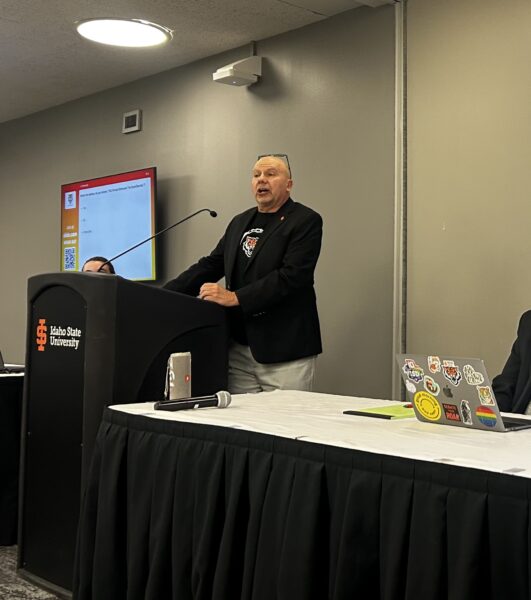
Mustafa Mashal, the special advisor to the vice president for research and economic development and a professor of civil engineering, was among the judges, stationed just above the crowd. Working with him were Wendy Ruchti, an associate professor of teaching and educational studies, and Jamie Howerton, an ISU Alumni Association executive board member.
“Do not think it is only about winning,” Mashal told participants. “Experiences like this are valuable chances to polish both your verbal and non-verbal communication skills.”
For some students like Cathcart, the interest in her discipline started personally, stemming from watching her sister struggle after being diagnosed with a rare, progressive neurological disorder. And after noticing how little her clinical psychology and disability studies courses intersected, she is working to create a more inclusive, integrated understanding of disability.
Similarly, Kimball’s interest in chemistry came from exploring the “mysterious and fascinating” topic in a high school AP class. He hopes to take this research even farther to give the field new tools and open the door for applications of sulfur that were not possible before. And although he set high expectations for himself to win, Kimball says he mainly focused on showing the audience how passionate he was about this work and why it was worth caring about.
For those considering participating next year, he recommends not focusing too much on the technical details and remembering to practice the delivery.
“Let your enthusiasm and personality show. Even with a strong script, low energy can make the message less impactful,” says Kimball, who hopes to work with Idaho National Lab and pursue a Ph.D. in chemistry. “However, remember most that even participation will make you a better communicator about your research to everyone, something that can be easily forgotten about when surrounded by other people in your field.”