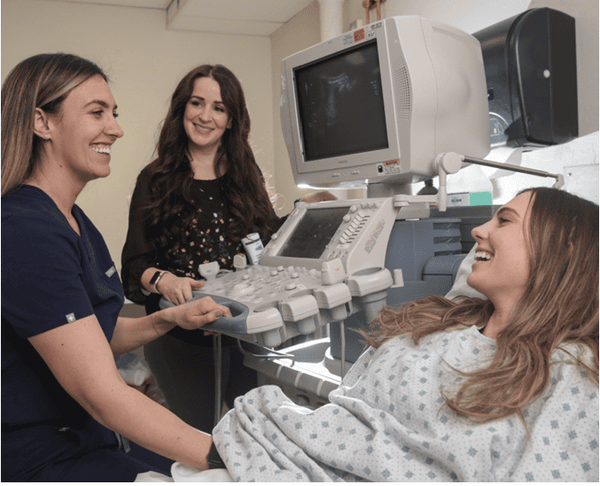
Photo Courtesy of Chelsie Wheatley
Rebecca Brainard
Staff Writer
There is something unsettling about receiving life-changing news while doing something entirely ordinary.
I was at home watching television with my husband when my friend Molly McBride texted me. She said she’d received upsetting news and was still trying to process it. I remember wondering what could have happened, never imagining what she was about to tell me.
After explaining she’d had a mammogram, follow-up imaging and biopsies, she wrote, “I have fucking breast cancer.”
I was scared for her and angry that someone so young had to face a cancer diagnosis. Her experience has changed the way I think about Breast Cancer Awareness Month.
When she went for her mammogram, McBride had no noticeable symptoms. She described her breasts as naturally dense and lumpy, making it difficult for her to notice anything unusual during occasional self-examinations. Her primary care provider had recommended screening for breast cancer the previous year, but she delayed making the appointment until her husband encouraged her to go.
“At just 44 years old, breast cancer wasn’t even on my radar. It felt like a possibility meant for a much later chapter in life,” she said.
The mammogram identified calcifications, which prompted additional imaging and a biopsy. Molly was subsequently diagnosed with invasive ductal carcinoma.
The U.S. Preventive Services Task Force recommends mammograms every two years for average-risk women ages 40 to 74. The American Cancer Society recommends annual screening beginning at 45, with the option to begin at 40.
Ellie Ryan, a physician assistant at Idaho State University’s Health Center, encourages women to begin annual mammograms at 40 and emphasizes the importance of knowing their family medical history.
“Family history is important to share with your provider,” Ryan said. “A family history of a first degree family member with breast cancer can double a person’s lifetime risk of breast cancer.”
For women who require additional evaluation, mammography and ultrasound often work together.
Chelsie Wheatley, a clinical associate professor in ISU’s Medical Imaging Department, explained that mammograms can reveal microcalcifications, tiny calcium deposits that sometimes indicate early cancer. Ultrasounds help determine whether suspicious areas are fluid-filled or solid.
Wheatley stressed the importance of regular screening.
“I know it tends to be a pain, and an inconvenience, but it is so important and can literally save your life,” she said.
The importance of screening is particularly relevant in Idaho. According to the Idaho Comprehensive Cancer Control Program, the state ranks 50th nationally for breast cancer screening, with approximately one in three Idaho women ages 50-74 not up-to-date on mammograms.
But early detection was only part of McBride’s experience. Molly works as a hotel manager and recently had to take time off of work for other medical issues. She said a lapse in insurance coverage complicated her efforts to schedule specialist appointments and added to her financial worries.
“I wish I had known how overwhelming the administrative and financial side of a diagnosis would be,” she said.
McBride said the experience has taught her the importance of seeking assistance from patient navigators, social workers and loved ones. She is also confronting uncertainty about treatment and possible changes to her body, including surgery, medication-related menopause and hair loss.
“Who will I even be on the other side of this?” she asked.
McBride’s diagnosis is a reminder that breast health matters even before the age for routine mammograms.
Ryan encourages ISU students to know what is normal for their bodies and seek evaluation for changes such as new lumps, nipple discharge, skin changes or unusual swelling.
“If you notice a change it is important to address it promptly,” Ryan said.
Students can receive an initial evaluation at the ISU Health Center and referrals for imaging when necessary.
“Students can be seen by a provider at ISU Health Center for free, even if they only have questions or concerns and do not want an exam,” Ryan said.
Idaho’s Women’s Health Check program offers screening assistance to eligible uninsured residents. Ryan also recommends healthy lifestyle choices including exercise, balanced nutrition and limiting alcohol consumption.
“Before my diagnosis, I saw pink ribbons as a gentle reminder to get checked,” McBride said. “Now, being on this side of it, I realize that awareness is only the very first step.”
She hopes Breast Cancer Awareness Month will also draw attention to affordable treatment, insurance reform and patient advocacy.
“Pink campaigns can feel glossy and clean, but breast cancer is terrifying, messy, and financially brutal,” she adds.
When McBride first told me she had breast cancer, I didn’t know what to say. I still don’t know what lies ahead for her. But her diagnosis has made breast cancer feel closer and more real than any awareness campaign ever could.
Molly McBride had no symptoms. She almost put off her mammogram another year.
Her experience is a reminder that screening isn’t just another appointment on the calendar. It can reveal something long before you know it’s there.