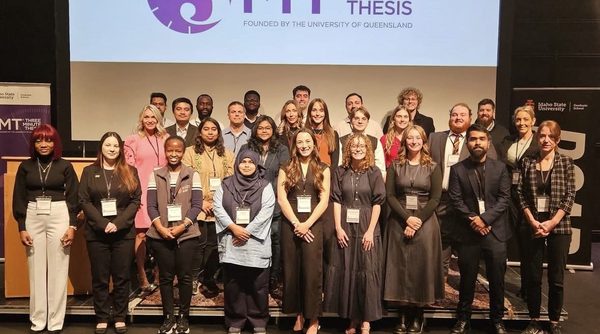
Photo Courtesy of idahostategradschool on Instagram
Jacki Donovan
Life Editor
On Thursday, Nov. 12, ISU’s Graduate School will host its tenth annual 3-Minute Thesis Competition, an academic event in which select graduate students must present the thesis of their research in three minutes.
Originally a part of the graduate school’s annual Research Symposium, the 3-Minute Thesis Competition has since taken on dedicated time and a new identity of its own with as many as thirty presenters taking the stage this year. It’s a setup that associate graduate school dean Dr. Tracy Collum describes as “very much like a TED Talk.”
The Bengal dropped by one of the Graduate School’s event rehearsals at the SPAC’s Black Box Theater to get a firsthand idea of the challenge that the competitors face.
As computer science doctoral student Andrija Sevaljevic points out, condensing any graduate-level thesis into 180 seconds is no small feat.
“You know, cramming multiple years of research into a three-minute speech that anybody can understand,” Sevaljevic says, “is gonna be a difficult task for anyone, no matter who you are.”
Sevaljevic’s co-competitor, English literature Master’s student Md Raisul Islam, arrived at a similar conclusion.
“So many things squeezing together within three minutes is challenging,” says Islam. “At previous conferences I’ve had 20-25 minutes to present.”
Condensing their research isn’t the only task presenters contend with. Competition procedure requires presentation of research in the simplest terms possible.
“The one key factor of the three-minute thesis is that [presenters] have to speak in layman’s terms,” says Collum. “They are not allowed to use a lot of scientific jargon, and that way anybody from any background could have a basic understanding of what they’re saying.”
Within the competition’s shared challenges, presenters rehearse guided by a great variation of philosophies. As it turns out, Islam, whose thesis looks to “excavate the psychological factors behind sticker use,” says he didn’t need to go to the traditional public-speaking pains to get his presentation in order.
“My preparation was choosing a topic which is very interesting to me,” says Islam. “I just observed what I observed, and that’s what I’m going to argue.”
Sevaljevic, for whom the preparation process has been somewhat more involved, elected to make use of prep opportunities offered by the Graduate School itself.
“Something I did which I recommend everyone does in the future,” says Sevaljevic, “is attend the [graduate school] insider sessions in order to get a better understanding of how the event is going to function.”
Sevaljevic’s thesis, as he explains it, deals with the expansion of “hands-on, interactive approach[es]” to AI to “accommodate students, the general public or really anyone interested.” It’s a complex enough idea to get across, even without the challenge of time and language constraints.
“You will be glad to know,” Islam says, “that the challenge is the privilege here.”
It’s obvious just from this dress rehearsal at the Black Box that challenging as it is, this is a privilege taken seriously by presenters and organizers alike. The nerves – and excitement – are palpable.
“Some of them don’t feel as prepared on Tuesday, but you won’t notice the difference on Thursday,” says Collum. “They will be excellent.”