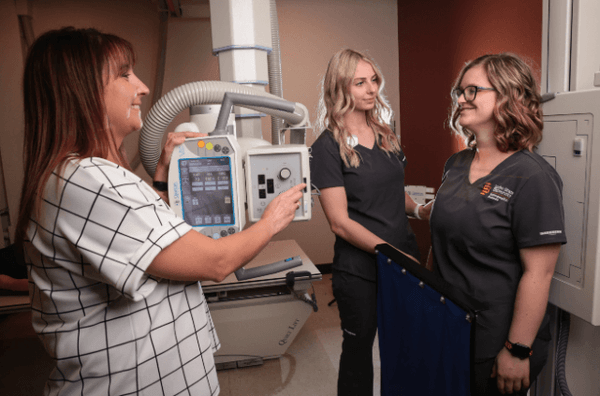
Photo Courtesy of Idaho State University
Rebecca Brainard
Staff Writer
ISU has received a $757,378 grant to expand its medical imaging programs, creating new educational opportunities for students while helping address a growing shortage of healthcare professionals throughout Idaho.
The funding, awarded through the Rural Health Transformation Program administered by the Idaho Department of Health and Welfare, will support three initiatives: expanding the radiographic science program into Idaho Falls, establishing a new echocardiography program and purchasing advanced simulation equipment for the diagnostic medical sonography program.
Chelsie Wheatley, clinical associate professor and director of ISU’s diagnostic medical sonography program, said the funding comes at a time when qualified imaging professionals are increasingly difficult to find. According to Wheatley, the Idaho Department of Labor’s January 2026 Eastern Idaho economic report ranked diagnostic medical sonographers as the region’s second-hardest occupation to fill, with cardiovascular technologists also ranking among the top ten.
“There are 26 current openings in Idaho alone for echocardiographers and all of the hospitals in the region have expressed a desperate need for cardiovascular technologists,” Wheatley said. “This opens that door.”
Currently, ISU’s sonography program trains students in general ultrasound imaging, but does not offer specialized cardiac sonography education. The grant will help provide equipment and simulation technology that will allow students to study ultrasound imaging of the heart.
The funding radiographic expansion into Idaho Falls will increase student enrollment and allow more students to continue their education closer to home.
Christopher Wertz, associate professor and chair of the Department of Medical Imaging and director of the radiographic science program, said the expansion will help prepare students to work in communities where access to medical imaging services can be limited.
“Radiographers are in high demand throughout Idaho, which includes many rural areas,” Wertz said.
By increasing enrollment and providing clinical rotations in rural healthcare settings, Wertz hopes more graduates will be prepared to fill positions in communities struggling to recruit qualified professionals.
“Rural health care allows people to stay near their homes to get the care they need and allows them quicker access to medical imaging in emergency situations,” Wertz said.
For patients in rural parts of Idaho, the shortage of imaging professionals can mean more than just an inconvenient appointment. Sonographers and radiographers perform examinations that help physicians diagnose conditions ranging from heart disease and blood clots to pregnancy complications and other medical emergencies.
“When these professionals are unavailable, patients may experience longer wait times for imaging, delays in diagnosis and treatment or the added burden of traveling to larger communities for necessary care,” Wheatley said.
She explained that traveling for care can also mean taking time off work, arranging childcare and additional financial burdens for patients already facing challenges accessing healthcare.
Another portion of the grant will address a different challenge facing ISU’s sonography students: limited opportunities for clinical training in obstetric, gynecologic and breast imaging. Wheatley said students do not always encounter the range of medical conditions they will need to recognize during their careers. New simulation equipment will allow them to practice scanning and identifying normal and abnormal conditions before performing examinations on patients.
“My students need hands-on OB and breast sonography training and to know what pathologies look like that they may not see in their clinical experience,” Wheatley said.
The technology will help students build confidence and develop essential skills before entering clinical settings. Wheatley, who assisted with equipment research and workforce data for the grant proposal, credited Wertz with completing most of the work required to secure the funding. She also acknowledged the support of ISU administrators.
Wheatley expressed relief at receiving the grant, saying, “This has been needed for a long time, and with state budget cuts, we have had significant financial barriers to growth.”
The Grant represents more than just an investment in equipment and facilities.
Wheatley believes students who complete their education and clinical training close to home may be more likely to remain in the region after graduation, helping strengthen healthcare services in communities where qualified professionals are urgently needed.
“My hope is that this expansion will create more opportunities for students in eastern Idaho to pursue rewarding careers in medical imaging without having to leave their families, communities and support systems behind,” Wheatley said.