
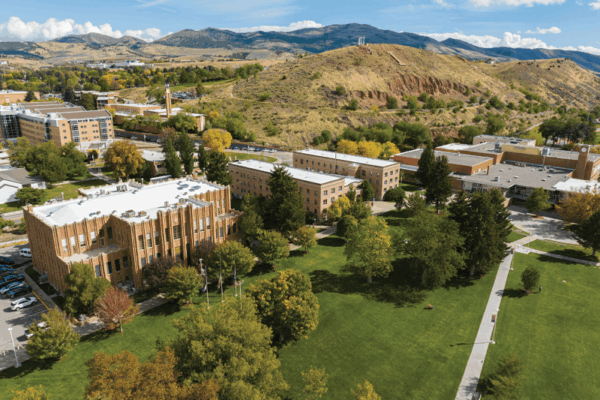
PHOTO CREDIT: Idaho State University.
Hadley Bodell
Editor in Chief
Idaho State University is facing a difficult time as statewide budget cuts to higher education have forced the administration to make decisions to get back in the black. President Robert Wagner commented on all things ISU —from the budget deficit to the subsequent layoffs.
“The balanced budget we celebrated on July 1 lasted about two and a half months,” Wagner said. “By the end of the summer, the governor’s office had announced the immediate 3% holdback for all state agencies, including higher ed.”
This budget holdback hit ISU leadership particularly hard. After spending their first couple of years in office working to get the university out of debt, President Wagner’s administration found themselves right back where they started.
Leaders of the university met to discuss where the budget could be adjusted following the statewide cut.
“We spent nearly three months engaging with our institutional community at an unprecedented level,” said Wagner. “We held town hall meetings, our colleges and departments met, offices met, all in an effort to solicit feedback, information and ideas to go toward our fantastic people.”
Wagner said these meetings and online forums left the university with hundreds of ideas. He said the engagement from the institutional community has been incredibly rewarding and satisfying, especially when the restructuring of the university is something the administration didn’t want in the first place.
“It’s something we didn’t ask for,” Wagner said. “It’s something that honestly, I wish we didn’t have to experience because we worked so hard to get to that balanced budget point.”
In creating the new plans, the focus was on the institutional values Idaho State University has held for so long. These include transparency, inclusivity, and integrity. The administration’s top priority has been the people.
“We took the first two weeks to talk to our people, to talk to the offices, divisions and colleges that would be the most impacted,” said Wagner. “Most importantly, to talk to people. Our plans involve a reduction of positions and people on this campus and we needed the time to talk to them individually.”
Employees had meetings with Human Resources and the university Provost where they were notified of their job status. Laid-off employees said these meetings were respectful and empathetic. However, many of the employees losing their positions are worried about the future of the programs they work in.
“The biology department needs an admin,” said Chelsea Wilkerson, an administrative assistant in the Biology Department. “How are they going to run without an admin? That is impossible.”
Joseph Crupper is another employee losing his job at the end of June.
“The things that I used to do are going to be pushed onto faculty and other staff members,” he said. “The students aren’t going to get the personable treatment that they used to get in geosciences because people are going to be stretched thinner.”
The university has expressed its deep concern for those who have lost their positions and has made every effort to limit the impact on personnel.
“It was very important we let them know now,” Wagner said. “They have about a four and a half month runway where they can look at other opportunities and our human resource office is prepared to help them with that.”
Regardless of the kindness and timeliness of the administration’s layoffs, employees are leaving behind the university community they’ve loved for years.
“It’s really upsetting to me, not only because I’m losing a job that I wanted to keep, but I also know that the students are going to be getting a less good version of what they have been getting,” Crupper stated.
In the wake of the legislation, Idaho State University is also undergoing a major restructuring. The College of Arts and Letters is combining with the College of Education. The administration says these restructuring efforts will allow for more student interdisciplinary studies and operational efficiencies.
Wagner reassures students in every program that their path to graduation is not impacted.
“They’ll see the benefits programmatically. The programs are not going away,” he stated.
The university sees this restructuring as an opportunity for students to have greater collaboration between the faculty and staff. On paper, the programs and colleges within ISU will look different, but the programs themselves remain to be what President Wagner calls “flourishing.”
President Wagner also told us this kind of change is necessary as time progresses.
“We’re going to do different. 2026 is different than 1901, we need to be a different institution, just like at one point we were an institute, then an academy and a Southern branch.”
By adapting with the times and always having the students best interest and experience in mind, the administration will spend the next several months implementing these changes and following the plan of the president’s Bold Path Forward.
“We’re going to adapt and evolve and we’ll change as an institution,” said Wagner. “Our faculty, our students are engaged and doing incredible things, they’re getting awards. We’re adding programs and building them in the health sciences. Our creative arts programs are flourishing and really serve the needs of our community. Our roots are strong and we will be successful.”

1