
Photo Courtesy of Idaho State Athletics.
Braxton Gregory Sports Editor
When the games end at Idaho State University, the work does not.
Across the athletic department, coaches, student-athletes and administrators spend the summer months preparing for the seasons ahead, though what that preparation looks like depends heavily on which sport is involved.
The NCAA governs off-season activity through a framework that treats each sport differently. Football programs operate under rules that allow some organized activities but stop short of full practice.
Basketball programs receive approved summer hours that more closely resemble in-season structure. Other sports, such as soccer, receive far less latitude, leaving athletes largely on their own until the official season window opens.
The distinctions exist in part to protect student-athletes from year-round physical demands while still allowing programs to develop their rosters.
“It is different for all of the sports, every team is different,” said Jonathan Match, Idaho State’s Associate Athletic Director for Sports Information and Media Relations. “Some teams, like the basketball for example, have approved summer hours by the NCAA where they are able to practice as a team, similar to what it would be like in season. Other sports, like soccer, do not have approved summer team practices, and they have to be much more self-led.”
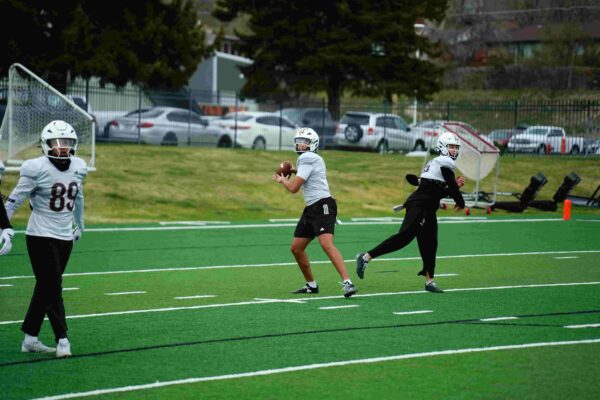
For Idaho State quarterback Jordan Cooke, that player-driven environment is not a drawback. It is an opportunity.
“Summer is definitely the most important time because the coaches aren’t gonna be around as much,” Cooke said. “It’s gonna be more player-led stuff. That’s really the time to hone in on the chemistry and the playbook and just get ready for the fall.”
Without coaches dictating every rep and every meeting, veteran players are expected to step into leadership roles. They run workouts, organize film sessions and hold teammates accountable in ways that can quietly shape a program’s identity before a single regular-season snap is taken. For a quarterback especially, summer is often when command of the offense is won or lost.
The urgency players feel on the field is mirrored in the offices above it. For Match and his staff, the off-season is the only time to tackle the backlog of administrative work that piles up when games consume the calendar.
Match is currently building a Football Single-Game Top 10 team record list, a section of the program’s record book that has never existed. The project requires combing through decades of physical box scores stored in a file cabinet, one season at a time across 45 statistical categories.
“It’s a part of the record book that we have never had, and I have needed it,” Match said. “So obviously that requires time and not getting pulled away to do other things.”
He has completed roughly 10 of the 45 categories so far. With the competitive season months away, he expects the research to move considerably faster.
“Once we are done with games for a couple of months, the project is going to move much faster,” Match said.
For Idaho State, summer is not a pause. It is preparation.