Photo Courtesy of Damrong Rattanapong, Shutterstock.
Madison Long
Life Editor
December 13 from 11 a.m. to 4 p.m., ISU hosted its free public E-waste Collection Event. With a disposal drop-off system wrapping around the first floor of the Pond Student Union Building, the event was in collaboration with Idaho National Laboratory, E-Cyclers of Idaho, Sunnking, and their project, “Comparing Strategies to Collect Battery-Containing Devices in States With and Without Electronics Recycling Laws.”
The project aims to address data gaps in residential E-waste recycling by correlating participation rates with sociodemographic factors, peer pressure, convenience, and communication methods. New York and Idaho were the selected representative states – Idaho for its rural area and for its lack of e-waste regulations.
“E-waste is a vital source of critical materials, and improving its collection and recycling is key to a stronger domestic supply chain,” said Ruby Nguyen, in the ISU press release. “We hope this collaboration sparks future events and broader adoption of responsible E-waste practices.”
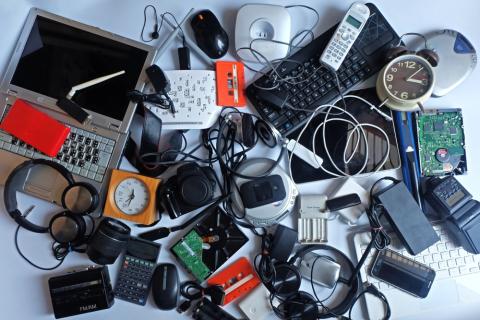
E-waste refers to any broken or unwanted device that uses electricity to function. According to the E-Cyclers of Idaho website, this includes computers, monitors, printers, keyboards, mobile phones, tablets, cameras, audio equipment, DVD and Blu-ray Players, game consoles, chargers and cords, batteries, electronic toys, electric hygiene products, power tools, calculators, and digital thermometers.
All these devices contain some form of valuable energy material, such as cobalt, lithium, nickel, graphite, gold, silver, platinum, palladium, copper, and aluminum. Materials like these are used in batteries for electric vehicles or for renewable energy storage. As well as in other electricity transmission projects.
“This work focuses on the very start of recycling, just after the scrap is collected and before we recover anything useful,” says Nguyen, Dynamic and Spatial Systems Analysis Group Lead at INL. “It’s all about making it easier to reclaim valuable materials from the devices we discard.”
However, according to the World Health Organization, E-waste remains one of the fastest-growing solid waste streams worldwide. And with no statewide mandate for E-waste recycling, E-waste can accumulate in landfills, polluting the environment with hazardous materials such as lead and mercury, which are among the 10 chemicals of public health concern.
Another common misconception – which became a frequently asked question for Pallavi Pokharel before the event – concerned personal data security. E-Cyclers of Idaho addresses this through their R2V3 certification, which requires all electronic recyclers to establish a data security program that prevents unauthorized access, disclosure, or loss of sensitive information. Techniques for disposal include overwriting, degaussing (decreasing a magnetic field for magnetic media), or physical destruction. Upon request, E-Cyclers will also produce a complete Certificate of Destruction.
“I think awareness and education is one of the pieces that’s really lacking for now,” says Pokharel, ISU’s Sustainability Manager, who joined the team this September. “So many people don’t even realize that e-waste contains both harmful components and also very highly valuable materials.”
There was no tonnage target set for ISU’s collection, and success was measured by community participation, advocacy, and awareness among students, as well as proper, secure recycling of electronics. After the event, those participating completed a survey.
While INL and E-Cyclers are planning collections through the Summer of 2026 to additional locations across Southeast Idaho, including Rexburg and Fort Hall, Pokharel hopes to open the opportunity to the ISU campus area, with Idaho Falls and its proximity to INL.
Pokharel hopes this event will help educate ISU students about E-waste, demonstrating that disposal can be safe, supported, and a step towards the future of ISU sustainability, just one step in an ongoing effort to bring sustainability to ISU. Her other plans include the recent launch of the campus Sustainability Club, the $5,000 Student Sustainability Grant, and the potential for an Earth Day workshop and a campus thrift store.
“Students are always key to me. I always say that students can get their voice out there,” says Pokharel. “Sustainability is not just about long-term goals. It’s also about taking physical, visible, or practical actions.”
Students with questions concerning ISU Sustainability are encouraged to contact Pallavi Pokharel. Her contact information can be found at www.isu.edu/ehs/about-us/ehss-staff/.