Austen Hunzeker
News Editor
To Book Bundle or not to Book Bundle is the question that’s been circulating at Idaho State University since the program launched in Fall 2024 — some saying they benefit from paying $24.75 per credit for their course textbooks, while others call it a total scam.
For ISU James M. & Sharon E. Rupp Debate Society’s public debate on Wednesday, Nov. 12, students voted earlier this year to make the Book Bundle the arguing subject.
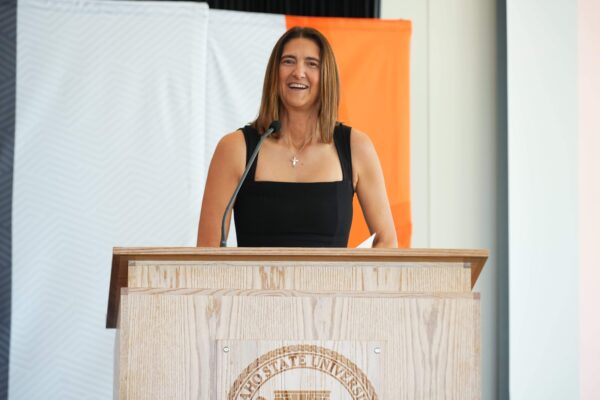
“Our debaters will tackle the central question: Is this new model a forward-thinking program that champions student equity and affordability? Or is it a digital monopoly that eliminates student choice and stifles the free market?” DiSanza said. “This program is controversial here at ISU to say the least.”
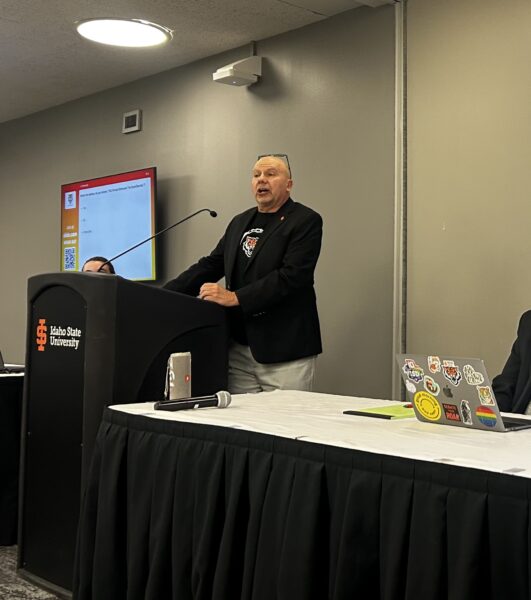
Following introductory comments by ISU’s Director of Debate and Forensics, Sarah Partlow Lefevre, DiSanza shared the history leading up to the current landscape of retrieving course materials. The Book Bundle is a result of a 2016 change of federal regulations that allows universities to bill for books and supplies as part of one’s tuition payment as long as three aspects are present: the university has a contract with a third party, the materials are offered below competitive market rates, and universities provide a way for students to opt out if they so choose. At ISU, students are automatically enrolled in the Book Bundle program and have to manually opt out if they wish.
Around 40 people attended and filled out a survey before and after the debate about their stances on the Book Bundle. ISU junior and philosophy major Jonathan Stoneback was assigned the affirmative team — arguing to eliminate the Book Bundle — and began the debate with the topic of affordability between academic programs.
“It’s only beneficial to STEM students,” Stoneback said. “Getting rid of the Book Bundle would keep humanity students from exorbitant textbook prices that don’t reflect the true costs of their necessary materials.”
According to Stoneback’s research, low-income students are less likely to enroll in STEM programs. The Book Bundle burdens already existing financial strains for these students by forcing humanity students to pay higher prices for materials. Stoneback also touched on opt-out barriers for the Book Bundle.
“The opt-out website and business model needs some work big time,” Stoneback said. “It’s not very user-friendly…It’s about a six-step opt-out process.”
Stoneback said he’s gathered a wide range of student perspectives on the Book Bundle because he’s involved in multiple departments — the common consensus being that the website makes opting out of the program difficult. He also explained that reforming the program would not be a timely solution.
“ISU has not signaled a change to their bundle model, so there is no horizon for a bundle reform,” Stoneback said. “We can only assume that the harms persist in the absence of another model.”
ISU sophomore Alex Kuyper was assigned the opposing team, in favor of not eliminating the Book Bundle. His primary argument centered on how the Book Bundle actually helps most students, his first point being cost predictability.
“The Book Bundle provides a clear, upfront cost,” Kuyper said regarding the $24.75 fee per credit hour. “But depending on what your major is and if you’re taking gen-eds or upper-level classes, what you pay for the materials changes every semester.”
According to Kuyper, this model avoids surprise textbook costs at the start of a semester. Based on his research, STEM majors spend around $1,000 a year on textbooks, meaning the Book Bundle saves these students about $250. The ISU bookstore manager previously told the debaters that ISU students saved over $723,000 just in the previous academic year.
“Not every student will benefit from being enrolled in the Book Bundle right now,” Kuyper said. “But the program benefits everyone in making decisions about class materials and is actively getting better.”
Kuyper shared that the bundle provides adequate information on rental vs. purchase prices and that creating a clear, accessible opt-out mechanism would enhance the program and is a better solution than abolishing it altogether.
“The bookstore manager told us that fewer than 1% of students requested to opt out after the deadline, indicating that the majority of students are well informed about the process and deadlines in advance,” Kuyper said.
Attendees were allowed to ask Stoneback and Kuyper questions before rebuttals, many of which led to further discussion about strategically opting in and out of the program. One attendee mentioned using thrift websites for her course materials.
“Honestly, if we were to link access to thrifting websites near the Book Bundle and have it as a resource, that would be good,” Kuyper said. “The Book Bundle is especially useful for classes that have to have either newly updated textbooks every single year or ones that are heavily copyrighted. But programs that really don’t care too much about textbooks would absolutely benefit from [thrifting websites].”
In his rebuttal, Stoneback begged the question of whether the Book Bundle has to exist for the price comparison tool to exist. He also mentioned how countless students, himself included, have not received their materials on time for class through the Book Bundle. In terms of cost predictability, he said it doesn’t correlate with affordability.
“I can see that I have to spend a million dollars, that doesn’t mean I can afford a million dollars,” Stoneback said.
Kuyper refuted this point, arguing that STEM majors still significantly benefit from the Book Bundle; therefore, it would be unfair to dismantle the program just to aid humanities majors. He also claims that the bundle is still in its infancy and has room for improvement.
“John correctly identifies how hard it is to opt out of the Book Bundle,” Kuyper said. “But when compared to other subscriptions like gym memberships and newsletters, at worst, the Book Bundle is as difficult as other subscriptions.”
Prior to the debate, 50% of attendees voted in favor of eliminating the Book Bundle, 33% against, and 17% undecided. Following the debate, 30% of attendees were in favor eliminating the Book Bundle, with 67% against, and 3% undecided.