
Madison Long
Life Editor
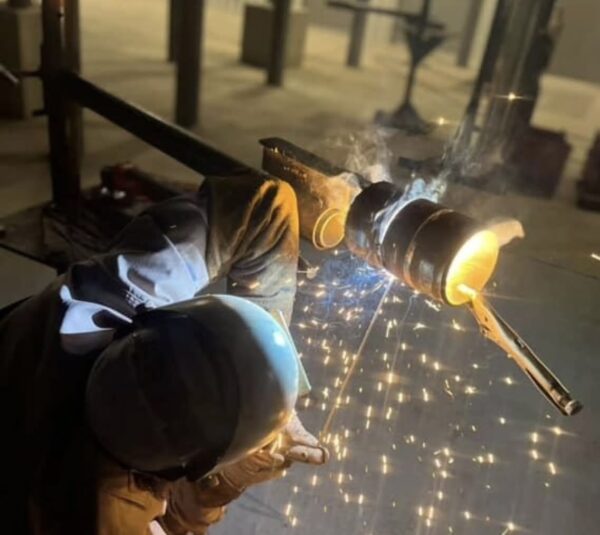
In September, the Idaho State University College of Technology welding program received an anonymous one-time donation to fund personal air respirator protection hoods (PARP) for all 65 students currently enrolled in the welding program. The idea is that students will use them during the program and then be able to take them after graduation. The donation is valued at over $80,000.
Since the first welding safety gear invented in 1800 – which consisted of little more than an opaque sheet and glasses – welding safety improvements have become a priority.
Previously, students at ISU used basic welding hoods, designed to protect a welder’s face, neck and head from intense light, heat and flying sparks. PARP hoods are designed to protect against gases released by metals while welding through a fan blowing filtered air inside the welder’s headgear.
Lucas Bloxham, the welding program coordinator, and clinical instructor, says that the PARP hoods aren’t necessarily essential for welding. Still, some companies and businesses that specialize in stainless steel welding might require them.
“A gift like this is huge for our students,” says Bloxham in the ISU press release. “Working with Norco and donations like this ensures our students are trained with the highest-quality equipment.”
The donation will be celebrated at the 3rd annual Gregory T. McHaley Safety Days, a Norco-sponsored event dedicated to educating ISU welders and exposing them to situations they might encounter in the workforce.
With around 5 to 10 industry experts present, welding students must attend these orientations on safety protocols such as fall and respiratory protection, hazardous fumes, and personal safety equipment.
According to the ISU press release, originally titled “ISU-Norco Safety Days,” had a name change proposal this year in honor of “Gregory T. McHaley, a welding graduate whose ISU legacy continues to impact industry and education.”
According to Bloxham, on any typical day, students are split into lab shifts.
Students in the morning shift weld in the lab five days a week from 7 to 11:30 a.m. From there, they attend a variety of six different related classes including 1st and 2nd year shop math, blueprint reading, mechanical drawing, metal layout, and welding theory. Bloxham mentioned that the afternoon shift works as an overflow where students weld and take classes from 1:30 to 8 p.m.
Degree options include a one-year general welding technical certificate, a two-year welding-fitter associate of applied science, a two-year welding-fitter advanced technical certificate, or a one-semester specialized certificate in nuclear welding.
“Our students get a lot of work in two years,” says Bloxham. “We specialize in pipe welding. That’s where the money’s at in our trade, and it’s something other schools don’t do.”
When asked what makes ISU’s welding program different from other welding programs in the state, Norco Chubbuck Branch Manager Ken Weaver said, “Have you got 25 minutes?”
“It comes down to the world-class instructors, the world-class facility, the tremendous support of the welding program through the ISU College of Technology, and their long history as a highly competitive environment where so many ISU students go out into the industry and run their own companies,” says Weaver. “Ultimately, ISU produces tremendous welders. They are just hands down some of the best welders in the industry.”